bela logo

bela logo
Showing posts with label Early Childhood Education. Show all posts

Tuesday, April 23, 2019

Potty Training Series : Post 1


One of the most common questions we hear at our Parent Information Night, or when a parent comes in to register their child for Pre-School is, “What about toilet training? We’ve started but he/she isn’t completely trained.” Since this is such a hot topic we decided to share a series of posts with some considerations,  information, tips and tricks.

From our experience, most children quickly become more independent with this important self-help skill, if the school and home work together, using the same process and language. Once the children are at school, and are using the bathroom with other children, they are motivated to learn/master these skills.

How will we know if our child is ready to be toilet trained? 


The simple answer is “when the child is ready” “Experts’ in the field of pediatrics and research may suggest anywhere from 18 months to thirty months, but all emphasize the importance of looking at specific indications that an individual child is ready to begin the toilet training process. This readiness requires predictable physical and behavioural clues that a child is ready to participate:


Is the child at least 18 months old?

Are the child’s diapers dry for at least 2 hours at a time?

Does the child know – and let you know- when he is wet or has a bowel movement?

Does the child tell you or indicate that she is uncomfortable in wet or soiled diapers?

Can the child sit upright for 5 minutes?

Can the child undress enough to sit on the potty?

Is the child able to get himself to the potty?

Does the child follow simple directions?

Does the child answer simple yes-and-no questions?

Does the child imitate others- parents, caregivers, or other children?

Does the child show pride, joy, or excitement when she/he learns a new skill?


It is important to consider that for potty training to be a self-help skill; a child has to take an active role in it. And in order to take an active role, the child has to be ready and able.


In addition, if a child is being toilet trained in a group setting, such as Pre-School, Day Care, or a Day Home, we also need to consider:

Does the child trust and feel comfortable with the adults who care for him/her?

Do the adults-parents and caregivers-know what they will have to do to help the child learn to use the potty?

Are the parents and caregivers willing and able to devote the time and attention to helping the child learn to use the toilet?

Have the adults – parents and caregivers- shared information with each other about how they plan to do the toilet training, so that the same methods and language are used at home and at Pre-School, Daycare, or at the Day Home?

Take some time to assess the readiness of your little one and watch for our next post where we will dive deeper into this important topic!

~JR

Tuesday, December 11, 2018

Photo Blog ......Family Learning Celebrations

Twice a year we invite our families to join us at BELA in the evening for our Family Learning Celebration. This is a chance for our parents to spend some time learning from their child,  about life at BELA and experience our daily routine . Our students are always so excited to have their parents attend! Your participation as a parent helps show your child that you value their education and are interested in their school. Parent involvement is directly linked to children's success in school! Thanks to all our BELA families for your participation.


Saturday, June 2, 2018

Adventures of a BELA Kid....

The end of the school year will be here before you know it and we intend to soak up every bit of sun and fun we can before then! Field trips, park days and playing with friends...... all captured here in this photo blog.....


Wednesday, February 28, 2018

Let's Pretend!


I don’t know about you, but some of my favorite memories from my childhood, are of pretending with my brothers, and my cousins! Little did we know, as we explored and searched for adventure, we were honing a wide variety of skills and knowledge, which would serve us well in our adult worlds later on in life.

For us, pretend play encompassed so many ideas and scenarios.  In a matter of about 10 creative minutes, we could design and build an airplane, made out of a saw horse, some planks, and a tin pail. As we collaborated and problem solved we gathered blankets, boards, cardboard, and a variety of broken down furniture, to create an amazingly strong and safe fort to defend the ‘western frontier’. Playing school involved organizing a wide variety of ‘school-like’ activities and always required some type of performance, whether for the Christmas concert, or other show providing chances for leadership and helping develop our confidence. Our childhood was a smorgasbord of pretend play choices: stores, hospitals, winning/loosing the ‘big game’, treasure hunts, museum building, hunting bears, sea voyages on our rafts down the river, and camp-outs at the beach, filled our days, enriched our lives, and unbeknownst to us, helped to prepare us for later success in life.


Pretend Play, or Make-believe Play, is an integral component of early childhood development. Dr. Scott Barry Kaufman, Jerome Singer and Dorothy Singer define pretend or make believe play as “the acting out of stories which involve multiple perspectives and the playful manipulation of ideas and emotions. They add  that this play “reflects a critical feature of the child’s cognitive and social development. The article provides a summary of some of the research related to the Need for Pretend Play in Child Development. The authors quote psychologist Sandra Russ, indicating she has identified a number of cognitive and affective processes that are associated with pretend play. The authors state that over the last seventy-five years a number of theorists and researchers have identified the values of such imaginative play as a vital component of the normal development of a child.


An article provided by Scholastic, describes the learning benefits of pretend play; stating "Young children learn by imagining and doing. They use objects to represent something else by giving it action and motion."  The author states "this pretend play is not as simple as it seems, and the process of pretending builds skills in many essential developmental areas, such as: social and emotional skills; language skills; thinking skills; and nurturing the child’s imagination".

Lauren Lowry, a Hanen Certified Speech Language Pathologist provides us with the How and Why of Encouraging Pretend Play.  Ms. Lowry describes the connection between pretend play and language. She states pretend play is also known as ‘symbolic play’ because it involves the use of symbols. "When we use something to stand for something else, such as when a child is playing and uses an object to stand for something else (e.g. using a spoon as a hairbrush or a tablecloth as a cape)." Lowry clarifies that, "this type of symbolic thought is also needed for language, as our words are symbols. Our words stand for our thoughts and ideas. Therefore, pretend play and language both involve the same underlying ability to represent things symbolically." In addition, language development is closely linked to learning to read and comprehend what has been read. This author provides information about why we should encourage pretend play, the stages of the development of these skills, and she includes valuable ideas for ways to encourage pretend play.


Pretend play is so important for so many different reasons! Some of the positive benefits of pretending include: helping children to gain practice using symbols, strengthening your child’s pretend skills, language skills, and later reading skills; exposing children to new vocabulary that they might not be exposed to in everyday life.  When you play with your child, you help them learn to play with others. Eventually your child will start to pretend with other children, where he will learn to take turns and collaborate. When children take on a pretend role, they imagine what it is like to be another person, which helps develop their ability to take another perspective and develop empathy.  Pretend play is fun! When you play like a child letting your imagination lead, you and your child will never run out of things to play. Can't you almost hear your childhood playmates calling you to come and play!? Join your little one as they pretend........magical, not to mention immensely valuable experiences await! 
~JR

Thursday, April 20, 2017

Buckets Full of Fun! ~ Photo Blog

Earlier this year, we were very honoured to be the recipient of the Brooks & District Chamber of Commerce - Community Spirit Award! This award recognizes businesses that have a high degree of community involvement, show support for seniors, youth and culture and act as community leaders by building on strengths within Brooks & area.

At BELA, we strive to give our students real world experiences that build on our Bucket Filling Philosophy!  Character Development is a building block of our program and we are always happy to make new friends, help other organizations and find fun ways for our students to bring smiles and happiness to others in our community.

We wanted to take the opportunity to share a post hi-lighting some of the community work we do with our students, that led to us being recognized as a leader in the area of Community Spirit!

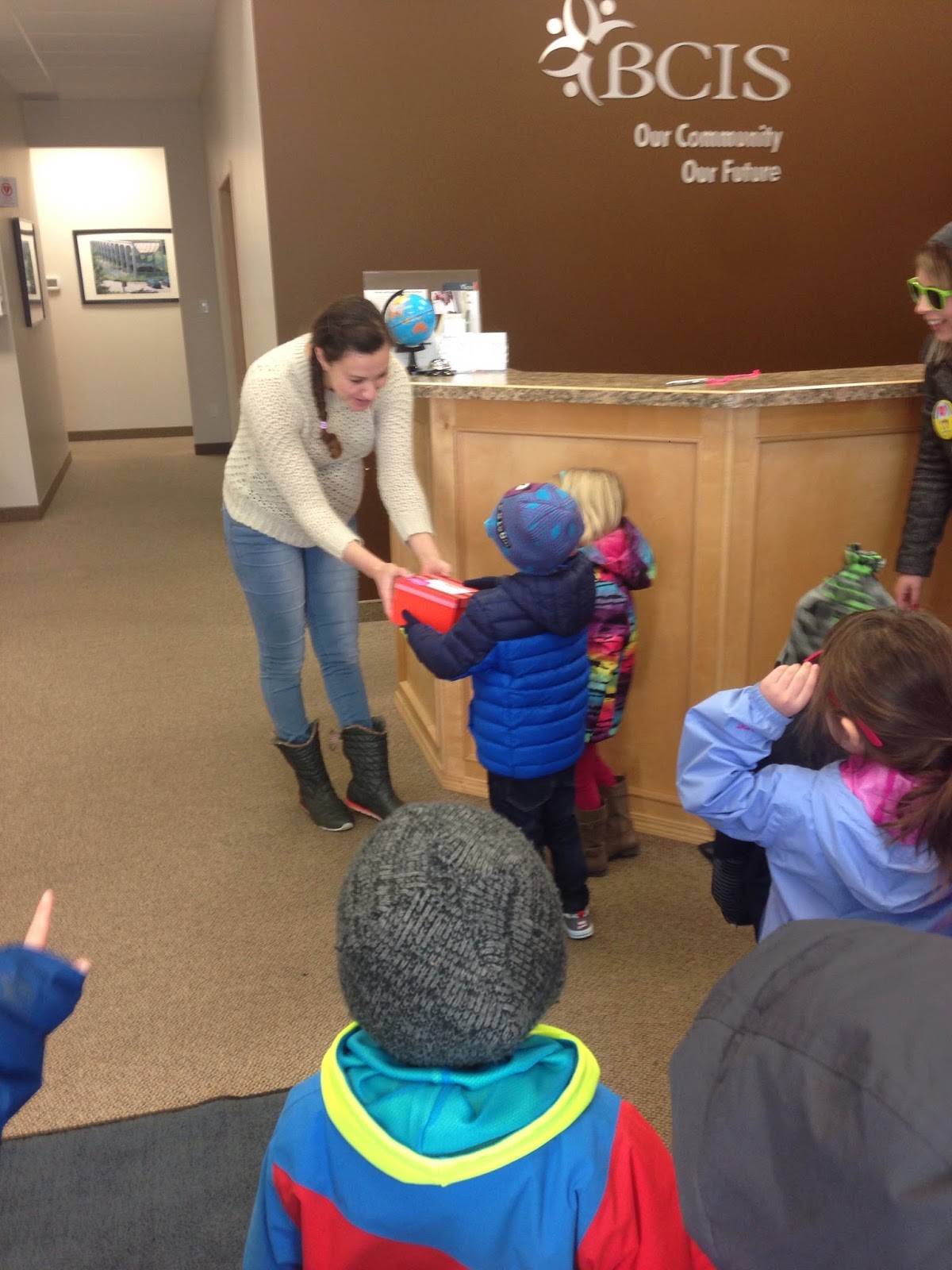
Christmas ornaments & new books for our Kindergarten friends in Fort McMurray, the BELA Run for Reading,  food drives for the Brooks  Food Bank Foundation, helping plant flowers at our home in South Shore Centre, delivering cookies, flowers and notes for  RAK Day (Random Acts of Kindness), visits to Newbrook Lodge,  & spending time with our new friends from Eastbrook Elementary ; its all here in this photo blog of community minded projects past & present!


Thank you to Scotiabank & the Chamber of Commerce for this wonderful award! We were truly honoured to win in this category because character development is such a big part of our program. Thank you to our teaching staff for taking the 'bucket filler' philosophy and integrating it into our program every single day; for taking ideas and translating them into real world learning experiences for our students.  Thank you to our parents for helping with all these activities and for allowing us to share your children with our community.  And most importantly, thank you to our students for the opportunity to teach the value of community and for reminding us everyday to find the joy in the little things, help others , share and be kind!!

~CP